
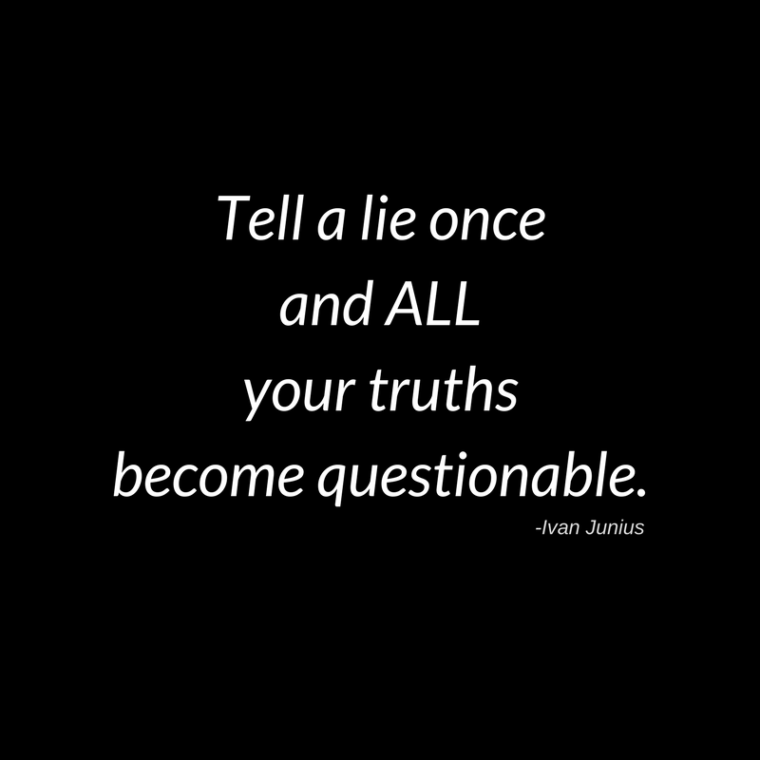
Once upon a time I worked for a charismatic leader with a serious set of skills. Someone I learned from constantly and deeply admired …
- Until I caught him in a lie.
- And then a second one.
- A third one.
- A fourth one.
- And finally a fifth one.
The crazy part was – I wasn’t hunting for lies. I literally kept tripping into them – all five in a very short amount of time after years of working together.
When I confronted for the last time. He said, “I don’t know how you keep finding these things out.” No denial. No excuses. No apology.
A short time later – I “fired him” by turning in my notice.
Titled leaders and employees can all be tempted to overlook honesty because of skill.
As a titled leader:
Have you ever hired someone – after it became clear that they lied in their interview?
- A seemingly tiny lie – like where they lived
- A bigger lie – like how long they’d held a job
- A bold lie – like having more education or experience than they do
How did that decision impact:
- Your business?
- Your customers?
- Your employees?
- You?
Would you do it again?
One really bad hire: Has created distrust, destroyed teams, chased customers away, killed profits – and eventually brought down the hiring managers that overlooked those lies.
Have you ever discovered that someone lied to you on their resume or application after you hired them?
- Do they still work for you?
Have you ever found out that someone falsified a report at work?
- What did you do?
- What message did you send to your other employees about the importance of integrity?
I’ve heard hiring managers justify skills over character, sales managers defend profit over truth and HR managers declare that they don’t legislate morality.
On the flip side of that, is the stand that Financial Guru Dave Ramsey has taken with his employees. If any of them cheat on their spouse they are terminated. He believes if someone will cheat on the person that is supposed to be the most important person in their lives – they will cheat on anything. And that lack of character will ultimately impact other employees, the workplace and his customers.
As a prospective employee:
Have you ever overlooked the character of the company because you had too much invested already?
- Have you ever discovered that the company that you just accepted a position with – is lying to you?
- What did you do?
This post describes a situation one of my expat neighbors faced two days prior to moving to Saudi Arabia.
As an employee:
Have you ever learned alarming things about the character of the company you just started working for?
- What did you do?
Have you ever allowed your character to be manipulated by a bully?
- Has your hiring manager ever demanded that you do something – and won’t put that demand in writing?
- Did you stand up to them – in spite of their anger?
People have lost everything from vacations to their jobs because they didn’t stand. Choosing to stand may also result in no job, but it doesn’t violate your conscience or tarnish your character.
Looking for a speaker or a facilitator for your next event?
Chery helps people and organizations accomplish their mission by facilitating truth-seeking, listening, dialogue, collaboration and growth:
- People work through divisive issues
- Students and professionals develop critical life and leadership skills
- Followers of Jesus find Biblical responses to the news and division in our world
Chery, Today was a hit! You were a delight and commanded the attention of all. We’ll be a better company. The feedback has been fantastic! Thank you for sharing your time with us.
–Teresa Knox, Founder and Former CEO – Community Care College, Clary Sage College, OK Technical College
Check out what others are saying

Excellent post Chery!
Lying is so difficult because we want to see the best in others so we make excuses for the small lies. I once worked with someone whose lies kept growing and growing. It got to the point that I stopped believing in everything she said or did. There ended up being no trust left.
Thanks Chery!
Agreed Terri – We want to see the best in others!
If we love them or had really trusted them – it is easy to make excuses for lying. Or to avoid smelling the smoke or following it to it’s source.
If we admire or need their skills it can be easy to dismiss their behavior and focus instead on the immediate results instead the future impact.
And if we have too much invested we can hate what is happening and feel like we have no choice but to accept the behavior.
When I discovered that a company I took a risk with looked much different on the outside than the inside… I left. Truth is, not only were they a poor match for me (and my integrity) but I was a poor match for them. We waved goodbye rather quickly. When we feel that lump in our throats and pit in our stomach growing, ignoring it never makes it go away.
Thanks, Chery!
Alli
I agree with Dave Ramsey on this one. Cheating is cheating, and it’s wrong.
I’m just as harsh about lying. Making mistakes is easy. I do it every day. But lying about them reveals a character flaw I’d rather not have to deal with.
If your skills are limited, but I know you’re going to use them to the best of your ability and be honest about them, we can always work with that.
How to use kinetic market. Kinetic marketing is a powerful tool that can help businesses reach their target audience and drive sales. By utilizing the principles of motion and movement, businesses can create dynamic and engaging marketing campaigns that capture the attention of consumers and drive them to take action. One of the key benefits of kinetic marketing is its ability to grab the attention of consumers in a crowded marketplace kineticmarket . With so many brands vying for attention, it can be challenging to stand out and make an impact. However, by using kinetic elements such as animation, video, and interactive content, businesses can create eye-catching campaigns that capture the attention of consumers and make a lasting impression. Another benefit of kinetic marketing is its ability to drive engagement and interaction. By creating dynamic and interactive content, businesses can encourage consumers to actively engage with their brand and products. This can lead to increased brand awareness, customer loyalty, and ultimately, higher sales. So, how can businesses effectively use kinetic marketing to drive results? Here are a few tips to get started: 1. Identify your target audience: Before you can create a successful kinetic marketing campaign, you need to understand who your target audience is and what they are interested in. By conducting market research and analyzing consumer behavior, you can tailor your campaign to resonate with your target audience and drive results. 2. Use compelling visuals: Kinetic marketing is all about creating visually engaging content that captures the attention of consumers. Use high-quality images, videos, and animations to create dynamic and compelling visuals that will draw consumers in and encourage them to engage with your brand. 3. Tell a story: One of the most powerful ways to connect with consumers is through storytelling. Use your kinetic marketing campaign to tell a compelling story that resonates with your audience and showcases the benefits of your products or services. By creating a narrative that consumers can relate to, you can build an emotional connection with your audience and drive them to take action. 4. Create interactive experiences: Kinetic marketing is all about creating interactive and engaging experiences for consumers. Use interactive elements such as quizzes, games, and surveys to encourage consumers to actively engage with your brand and products. This can help drive brand awareness, increase customer loyalty, and ultimately, drive sales. 5. Measure your results: To determine the success of your kinetic marketing campaign, it’s important to measure your results. Use analytics tools to track key metrics such as website traffic, engagement rates, and sales conversions. By analyzing this data, you can identify what is working well and what areas need improvement, allowing you to optimize your campaign for better results. In conclusion, kinetic marketing is a powerful tool that can help businesses reach their target audience and drive sales. By creating dynamic and engaging campaigns that capture the attention of consumers, businesses can drive engagement, build brand awareness, and ultimately, increase sales. By following the tips outlined above, businesses can effectively use kinetic marketing to drive results and achieve their marketing goals.